
|
Home  Teaching and Learning Educational Psychology Cognitivism Teaching and Learning Educational Psychology Cognitivism |
 |
Related Links |
Cognitivism
Cognitive Theories of LearningAssumption: you can't force someone to learn
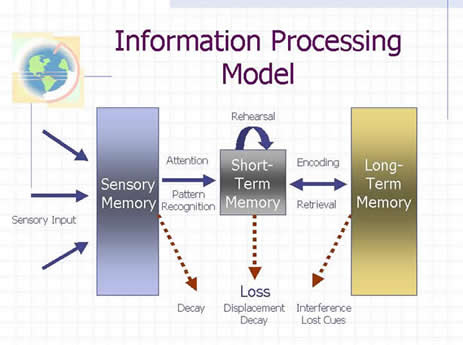
The main assumption of cognitive psychology is that there are cognitive processes that take place and influence the way things are learned. Explanations for how cognitive processes work are known as information processing theories or models. The three-component model of information processing is taught in Educational Psychology. It looks something like this:
Important classroom principles from cognitive psychology include meaningful learning, organization, and elaboration. Create an environment where there are lots of manipulatables, tools where they can develop an understanding. An instructor can ask questions to help students refine their thinking and recognize where they may be wrong. Failure may be considered a good thing as it is a tool to help learners realize that they need to learn more. Role of the instructor: monitoring their progress, asking lots of questions In this section,
we also discuss higher-level thinking skills such as metacognition,
study strategies, transfer, problem solving, and critical thinking.
Neural network Transfer and Learning to Learn - collection of links to materials and papers discussing neural network transfer and learning to learn theories and research. Designing Effective Learning Environments: Cognitive Apprenticeship Models - paper by S. E. Berryman discussing the problems with traditional theories and describing an apprenticeship models for classroom learning.
 |
|
© 2011 Richard Culatta
 Cognitive
theory defines learning as "a semi-permanent change in mental
processes or associations." Cognitivists do not require an
outward exibition of learning but focus more on the internal processes
and connections that take place during learning.
Cognitive
theory defines learning as "a semi-permanent change in mental
processes or associations." Cognitivists do not require an
outward exibition of learning but focus more on the internal processes
and connections that take place during learning.