
|
Home  Instructional Technology Modular LMS Instructional Technology Modular LMS |
 |
Related Links |
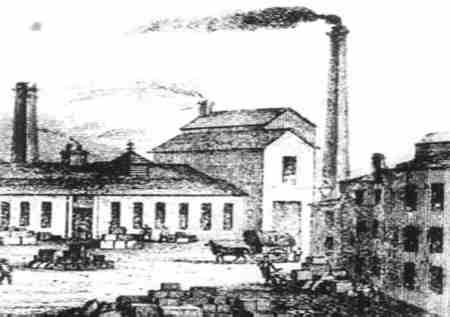
The Traditional LMS is Dead: Looking to a Modularized FutureThe future of LMS in higher education needs to be the subject of vigorous and The traditional stand-alone learning management system (LMS) is build on an industrial age model. There are two specific problems with this model, first it is monolithic within a learning institution and second it is generic across learning institutions.
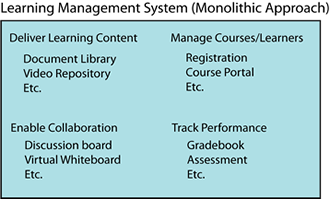
The first element, the fact that the traditional LMS model is monolithic, means that it attempts to include all possible online learning capabilities in one single application. The approach is built on the assumption that one software tool is flexible enough to provide the entire range of functionality needed to deliver an effective learning experience. Unfortunately, like many all-in-one products, in the process of trying to do everything, they end up not doing a very good job at anything. The monolithic nature of the traditional LMS is a concern articulated by Bush and Mott (2009) who express their frustration that the principles of modular design that caused exponential advances in the computer industry have been notably absent from the LMS industry:
In addition to compromised functionality, the monolithic nature of the traditional LMS also means that a single vendor is responsible for developing and keeping on top of all advances in the technology for all aspects of online learning experiences. This model was plausible when the required functionality for delivering online learning consisted of hosting documents and text-based discussion boards. As online learning experiences become more social, and therefore increasingly interwoven with collaboration technologies, attempting to develop all of the required functionality under one digital roof is simply not sustainable. Finally, the monolithic approach means that the most valuable resource of a learning organization, the learning content, is held hostage by a single corporate entity in a proprietary format. [add quote from Hamish article here].
The second element of the industrial age LMS model, that it is generic across institutions, is perhaps even more disconcerting. In the traditional model, the decision of what functionality to included in the system is determined well before the tool is implemented at any educational organization. Since it is not economically advantageous for software developers to build a customized LMS tailored to the needs of each institution, a single format is developed independent of any particular institution and then distributed to all environments. Thus, in addition to the problem of being monolithic within a given organization, the systems are also identical across organizations. The LMS design process may have the unintended consequence of homogenizing the design of learning experiences across institutions, since the basic format of the system has been pre-determined long before it gets to the hands of the instructors (Hamish & Coates, 2005). The issue of customizability can be summarized by a statement made by the chair of a department of education who observed:
The generic nature of the traditional LMS model means that the uniqueness of any given learning culture is undermined by a model that is more profitable for software developers. "Teachers and students are not free to choose the right / best / preferred tool for each teaching or learning activity they undertake, thus creating a technology paradigm that artificially limits possibilities and forecloses optimal teaching and learning choices" (Bush & Mott, 2009). This seems even more ridiculous if illustrated with a traditional classroom teaching environment. Imagine if every classroom facility were built with the identical set of floorplans regardless of whether it was a small elementary school, a high school for special needs students, a large college campus, or a government training facility. Clearly the needs of each organization are unique (some require a few small classrooms, others require large labs, others need large auditoriums, etc). Furthermore, the only options for customization would be to paint the walls a different color, choose to not use certain rooms, or pay lots of money to have a clumsy addition stuck onto the side of the building. Clearly this could not possibly meet the needs of such diverse cultural and pedagogical organizations, yet that is exactly the physical equivalent of what happens in the online learning space. Mash-up LMS: A Better Approach
In much the same way that electricity transformed factories from monolithic systems into a modular system of systems, the internet has transformed knowledge from static tomes into modular, customizable building blocks. This is perhaps best exemplified with proliferation of media mash-ups. Mash-ups are a unique user experience created by combining multiple separate media, data, or system functionality to create a new product. One example of a mash-up is placing photos (from a tool like Flickr) on top of a map (like Google Earth) to view where the photos were taken (see www.Panoramio.com). (For more examples of mash-ups, check out www.innvativelearning.com/mashups.html). Mash-ups differ from all-in-one products in the fact that instead of adding new features to existing tools, they combine existing tools that already have the desired features. All tools work independently, but create a uniquely customized experience when used in harmony. New products can be created simply by adding additional media or functionality to the mix.
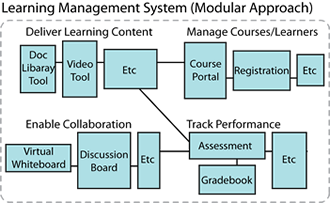
We can apply this same concept of modularization and customization to learning systems. Like the examples above, a mash-up or modularized LMS would have the potential to be both infinitely customizable as well as take advantage of current best-of-breed tools. To distinguish from the traditional LMS, we might refer to this approach as a Modular LMS. In order to understand the idea of a Modular Leaning Management System, it is important to first modify our use of the word "system" (as in Learning Management System). In the legacy LMS paradigm, "system" was synonymous with a single all-encompassing tool or software application made up of a variety of different internal functions. The modular approach shifts the definition of "system" to mean a collection of interoperable items that comprise a learning platform. A Modular LMS applies the model of "loosely coupled systems", often used to describe educational organizations, to a technical context. Loosely coupled systems are those whose component parts are responsive to each other, but retain their individual identity. In this sense, the parts of a Modular LMS retain their own specialized functionality, but work together to deliver a tailored learning experience.
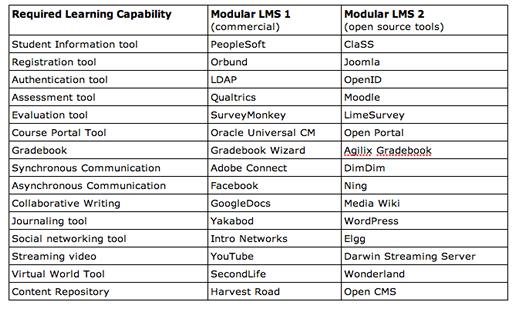
Benefits of a Modular LMSThe idea of combining multiple tools to create a mash-up LMS has a number of advantages. First, each system can be uniquely customized for a specific setting. An organization that provides primarily self-directed learning could choose tools that provide capabilities for facilitating asynchronous online learning. An institution that prides itself on providing lots of dialogue between students and teachers, could choose tools that allow for real-time interaction between online course participants.
Second, whether the Modular LMS is a simple combination of two tools or as complex as the examples shown above, the best systems can be chosen to support each of the desired functionalities. In this regard each learning requirement would be supported by the best-of-breed tool for that particular need. Third, the individual parts of the system become "hot swappable". As requirements change or more powerful tools become available, parts of the system can be swapped out or upgraded without adversely impacting the rest of the system. In addition if there is a technical problem with any given part of the system it can be replaced or repaired without inhibiting students from participating in activities in other parts of the system.
Related Articles
 |
|
© 2011 Richard Culatta

 Michael Bush, Jonathan Mott. "