|
|
Home  Educational Psychology Educational Psychology |
 |
Related Links |
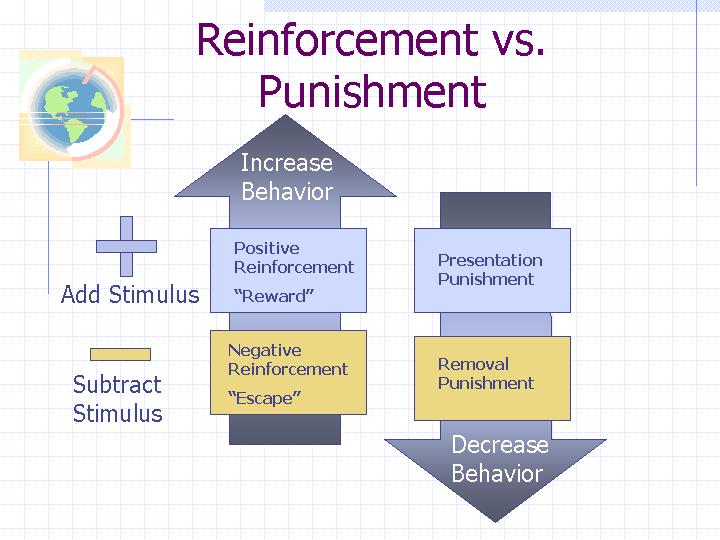
BehaviorismBehavioral theories define learning as a "semi-permanent change in behavior." In other words, learning has only taken place if a change in behavior is evident. Pure behaviorists are not concerned with internal process, but with external exibitions. There are two main theories involved: Classical conditioning and operant conditioning. Classical conditioning hearkens back to Pavlov's experiment with his salivating dogs. It's basic premise is that behaviors can be conditioned by pairing stimuli with responses. Educational examples may include test anxiety or a general dislike or enjoyment of a subject. In classical conditioning, responses are involuntary. Another type of behaviorism is operant conditioning, which involves the use of reinforcement to encourage behaviors. There are several kinds of reinforcers, and reinforcers may vary from student to student. Responses are voluntary in operant conditioning The key thing to remember in this section is that, in Educational Psychology, we are concerned with the use of behavioral methods to encourage learning rather than for classroom or behavior management. Key Questions to Ask About Behaviorism:
Example from the classroom: Kelly and Susan Adams
(compare this to the examples on motivation theory)
Pavlov Skinner
Bandura
Thorndike Links
Behaviorism Links
Example Reinforcement Project Behavior Modification of Nail Biting and Nail Picking [.doc]. Take a look at this sample student project by Colleen A. Student from Loyola Marymount University. It's more than you need to do for your project, but it may give you some good ideas.  |
|
© 2011 Richard Culatta